An Often Overlooked Pillar of Bangladesh’s Education System
Bangladesh’s education system runs in three parallel streams: the general stream, the technical/vocational stream, and the madrasah stream. The last of these is far more significant than it is often given credit for. The Bangladesh Education Article at Wikipedia notes that secondary education offers students the option of a religious stream — the madrasah — alongside the general curriculum. Madrasahs serve hundreds of thousands of students, particularly in rural and semi-urban areas where public schools are scarce, teachers are absent, and families prefer an education that combines secular learning with religious grounding.
Yet Madrasa education has long been underfunded, under-resourced, and left to operate with aging infrastructure and limited teaching materials. The government’s education budget — already low at around 2% of GDP, compared to a global average above 4% — has chronically prioritised the general stream over religious education institutions. The result is a sector that serves some of Bangladesh’s most vulnerable communities with some of Bangladesh’s most limited resources.
Three Institutions, One Commitment
The IGMIS Foundation has directed attention and support to three madrasahs: Sayadhangora Meftahul Ulum Koumi Hafijia Madrasa, Chabbisha Yusuf Ali Dakhil Women Madrasa, and a Madrasa in Pepulbaria, Sirajganj. Each of these institutions serves communities that mainstream development programmes often bypass — including, importantly, women’s religious education through the Chabbisha Yusuf Ali Dakhil Women Madrasa.
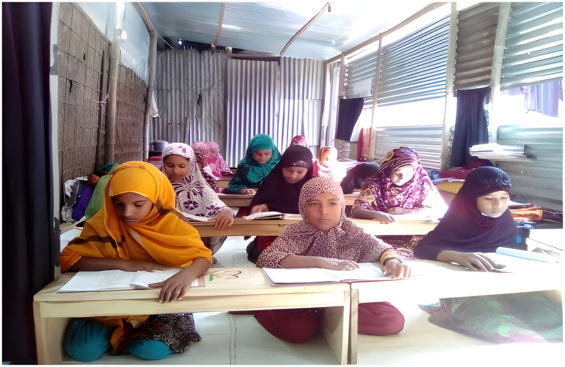
The Foundation’s engagement with these institutions reflects a clear-eyed understanding: that improving education in Bangladesh cannot be limited to English-medium universities and corporate training programmes. It must reach the students whose families have placed their trust in the madrasah system — students who deserve the same quality of facilities, materials, and support as those in any other educational stream.
Why Women’s Madrasa Education is Particularly Important
Bangladesh has made impressive gains in female primary and secondary enrolment, achieving near gender parity in primary education. But the UNESCO data referenced in education research on Bangladesh also shows that upper-secondary enrolment drops sharply for girls — from 87% at lower secondary to 53% at upper secondary — driven by early marriage, family pressure, and poverty. For many rural and conservative families, the women’s madrasa is not a compromise — it is the only socially accepted pathway to education for their daughters.
Supporting the Chabbisha Yusuf Ali Dakhil Women Madrasa is, in this context, a feminist act as much as an educational one. It means working within the community’s values to expand the education of girls who might otherwise receive none.
Education Is a Long Game
The IGMIS Foundation’s madrasa work will not make the evening news. There are no dramatic cheque handovers or viral photographs from a women’s madrasa classroom in Sirajganj. But generations from now, the graduates of these institutions will be better equipped because someone paid attention when others looked away. That is the kind of development that lasts.