A Country With Talent, A System That Doesn’t Always Find It
Bangladesh is a nation that loves sport. Cricket is practically a religion; football fills streets and tea-shop screens; kabaddi, volleyball, and badminton pulse through neighbourhoods from Chattogram’s port districts to the chars of the northern rivers. The country’s young people are athletic, competitive, and hungry for opportunity. And yet, as the Daily Star noted in its comprehensive review of Bangladesh Sports in 2024, the nation’s sporting infrastructure continues to suffer from persistent underfunding, gaps in coaching quality, and a structural failure to develop talent at the grassroots level.
A research study on Bangladesh’s athletic development landscape found that 83% of respondents rated sports funding as ‘average to poor’ and 87% gave the same assessment to infrastructure. The government has responded with ambitious plans — proposing 20 sports development projects in the FY2024-25 budget and constructing mini-stadiums at the upazila level — but the ground reality for most colleges and universities is one of limited space, limited equipment, and a cultural tendency to treat physical education as less important than academic performance.
A PLOS One study conducted in Dhaka found that physical activity was not prioritised in most urban schools for two core reasons: a general underappreciation of its importance, and the fact that PE classes did not contribute to academic grades. When sport is invisible on a report card, it becomes invisible in a student’s life.
The Hidden Cost of Not Playing
The consequences of this neglect are significant and well-documented. A landmark 2025 meta-analysis published in the International Journal of Behavioral Nutrition and Physical Activity — reviewing longitudinal research from childhood to adulthood — found that youth sport participation had measurable positive effects on physical activity, health and wellbeing, and reduced mental ill-being. Separate research in the journal Pediatric Exercise Science found that organised sport participation was associated with a 20% reduction in overweight or obesity risk among elementary school children, reduced cardiovascular risk, and better mental health outcomes that persist into adulthood.
The social benefits are equally compelling. Decades of research summarised by Athlete Assessments show that sport participation is linked to higher academic grades, lower dropout rates, reduced truancy, and lower crime rates. The numbers are striking: studies across multiple school districts found that 96% of students who dropped out were not participating in any athletic programme. Sport, in other words, is not a distraction from education — it is one of its most effective complements.
For Bangladeshi students navigating intense academic pressure, limited employment prospects, and the psychological weight of economic uncertainty, the mental and social benefits of organised sports are not peripheral. They are urgent.
What IGMIS Foundation Does: Putting Sport on the Calendar
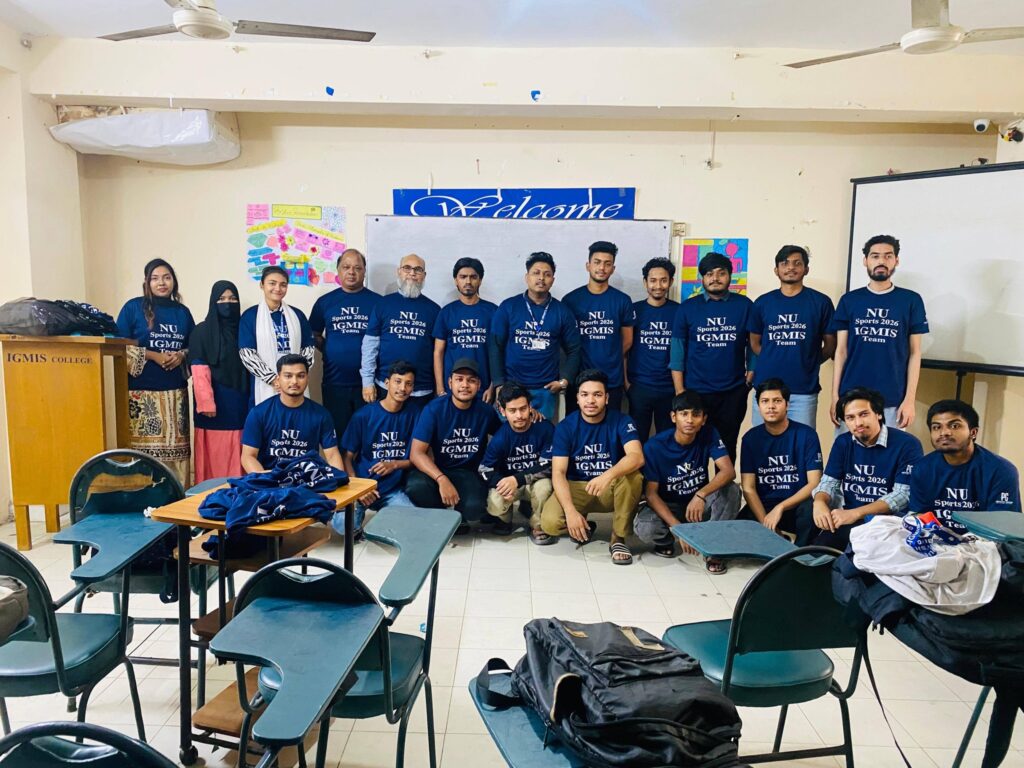
At IGMIS — the Foundation’s affiliated Institute of Global Management and Information System in Mehedibagh, Chattogram — the leadership has made a deliberate commitment to bringing sport into the fabric of student life. The Foundation organises sports events and inter-class competitions on campus, creating structured, inclusive, and regular opportunities for students to compete, collaborate, and simply play.
This is more significant than it might appear. In an environment where most private colleges in Bangladesh treat extracurricular activity as an afterthought — where students move from classroom to home with little structured engagement in between — the act of building a sports culture on campus is an act of institutional intention. It says: the whole student matters here, not just their exam results.
The sports events at IGMIS serve multiple functions simultaneously. They are occasions for physical activity in a country where urban youth are increasingly sedentary. They are opportunities for BBA and MBA students — many of whom come from modest backgrounds and are navigating university life for the first time — to develop confidence, communication, and competitive spirit in a low-stakes, supportive environment. And they are community-building exercises that bind together a student body that might otherwise remain a collection of individuals passing each other in corridors.
Sport as Leadership School
There is a reason that 95% of Fortune 500 executives — according to long-running research cited by Athlete Assessments — participated in organised sports during their education. Sport teaches things that no lecture can: how to lose without being broken, how to win without losing perspective, how to function as part of a team when you are tired and frustrated and the outcome is uncertain. These are the skills that separate good graduates from genuinely effective professionals.
For students in IGMIS’s BBA and MBA programmes — programmes designed to produce business leaders and managers equipped for a globalised economy — the cultivation of these qualities through sport is not separate from the academic mission. It is part of it. A student who has captained their class cricket team, managed the logistics of an inter-department football tournament, or rallied teammates through a difficult volleyball match has exercised real leadership muscles. They have experienced, in miniature, the dynamics of every workplace challenge they will encounter for the rest of their careers.
This is a vision of education that Bangladesh’s own Ministry of Youth and Sports has long articulated but struggled to operationalise in most institutions. The ministry’s mandate explicitly includes programmes that encourage a sense of adventure, responsibility, confidence and achievement in youth. The IGMIS Foundation is living that mandate at the institutional level.
The Equity Dimension: Making Sport Accessible
In Bangladesh, as in much of the developing world, sport participation is shaped by economic inequality. Expensive gear, club membership fees, and travel costs for competitions price out lower-income youth before they ever get a chance to discover what they are good at. This is compounded by the gender dimension — research consistently shows that girls receive fewer sport opportunities than boys, and that without deliberate institutional effort, sport programmes replicate rather than challenge existing inequalities.
The IGMIS Foundation’s campus sports events sidestep these barriers by design. When sport is organised on campus, during or around academic hours, using shared facilities, and at no additional cost to students, access is democratised. A scholarship student from a rural district competing alongside an urban classmate in an inter-class match is participating in something much larger than a game. They are experiencing a level playing field — perhaps for one of the first times in an educational career shaped by inequality.
Sport, Society, and Bangladesh’s 2041 Vision
Bangladesh’s ambition to reach upper-middle income status by 2041 will not be achieved by economic growth alone. It requires a generation of citizens who are healthy, resilient, socially skilled, and psychologically equipped to lead in complex, high-pressure environments. Sport is one of the most cost-effective ways to build that generation — a fact increasingly acknowledged in national policy but inconsistently implemented at the institutional level.
Every inter-class match that IGMIS Foundation organises, every student who competes and sweats and cheers and argues and learns to shake hands at the end — these are small, cumulative investments in the kind of nation Bangladesh is trying to become. The IGMIS Foundation understands that development happens on the pitch as well as in the classroom, and it has built both into the life of its institution.
Because the students who will run Bangladesh’s businesses, lead its organisations, and shape its public culture in 2041 are sitting in classrooms right now in Mehedibagh, Chattogram. How they learn to compete, to collaborate, and to carry themselves through challenge — that is being decided today.